Hackathon · SprintLY 2026 · Won

Ally

Every client has a story. Ally helps the RM remember it.

A relationship manager (RM) at a personal wealth management firm can look after dozens of clients worth tens of millions of rupees each. The firm's systems hold the data. The relationship (what a client fears, what was promised, when they prefer to be called) lives in the RM's head, and it leaves when the RM does. In two days, our team designed and built Ally: an AI copilot that helps the RM remember every client relationship day to day, and hands that memory on to the next RM when a client changes hands.

Event

SprintLY 2026, Lemon Yellow's first internal hackathon: 2 days, 3 teams

Result

Won

Team

15 people: 6 UX (3 designers, 2 researchers, me), 2 visual designers, 1 motion designer, 2 marketing, 2 business development, 1 project manager, 1 developer

My role

Design lead, working with the tech, marketing and business teams; hands-on for several screens

What we made

A working prototype, a product deck and a demo video

Industry

Fintech · Wealth management

Product areas

AI copilot · CRM and relationship management · Hackathon prototype

My role & responsibilities
Leadership
Led the design side of a 15-person team, working with the tech, marketing and business teams
UX design
Hands-on for several screens
AI product thinking
Memory, approval and handover flows
TL;DR

For recruiters deciding whether to read on.

2Days to build
15People on the team
3Teams in the hackathon
16Topics in the handover checklist
4Design decisions

Result

WonResult

In two days, our 15-person team built Ally, an AI copilot that remembers client relationships for relationship managers (RMs) at a personal wealth management firm, and lets a new RM rehearse a handover by having a conversation with AI versions of the client and the previous RM. It won Lemon Yellow's first internal hackathon, SprintLY 2026, and the agency now uses it to show clients how it builds AI into a product, not just the product itself.

In short: the brief asked for an AI-integrated platform for RMs. We designed for trust before automation. Ally prepares the RM, captures what was said with the RM's approval, explains why each next step matters, and lets a new RM rehearse a handover by talking to AI versions of the client and the previous RM.

What I learned
  1. Don't stop at the first idea. On client projects, we usually perfect one idea before moving on. Here, we built a version, then picked up the next idea, and the next. Each finished feature showed us what the following one should be.Read more ↓
  2. Trust comes before automation. The recording idea only made sense after the earlier features earned the RM's trust. Showing source, confidence and an approval step is what makes AI acceptable in a high-trust job.Read more ↓
  3. A room of disciplines moves faster than a pipeline. With design, development, visual, motion and marketing working side by side, the name, mascot, video and backend arrived alongside the screens, not after them. Two days was enough for a working prototype.Read more ↓
How I evolved
  • Thinking → From screens to AI behaviour: what it remembers, how it explains itself, and when a person approves.Read more ↓
  • Process → Prove one complete loop first (prepare, capture, follow through), then build on it.Read more ↓
  • Leadership → I led the design side and kept one concept together while collaborating with several leads at once (development, visual, motion and marketing) during a hectic 48 hours.Read more ↓
03

The problem: the CRM stores data, the RM carries the relationship

The hackathon brief was open: design an AI-integrated platform for a relationship manager at a financial advisory firm. We spoke to a colleague who had worked in that world. She explained that RMs play two roles: winning new clients, and keeping existing ones. We chose the second, because that is where the long-term relationship lives.

Before every meeting, an RM needs four things: what matters to this client now, what has changed, what they promised last time, and how to approach the conversation. That context is scattered across the CRM, spreadsheets, email and memory. Meetings can be two weeks apart, with a dozen other clients in between.

The cost isn't only preparation time. It's missed context, missed promises, and fragile handovers. When an RM leaves, the next one receives the data, but not the reasoning, the trust history or the nuance.

Decision 1Start from the client, not the spreadsheet

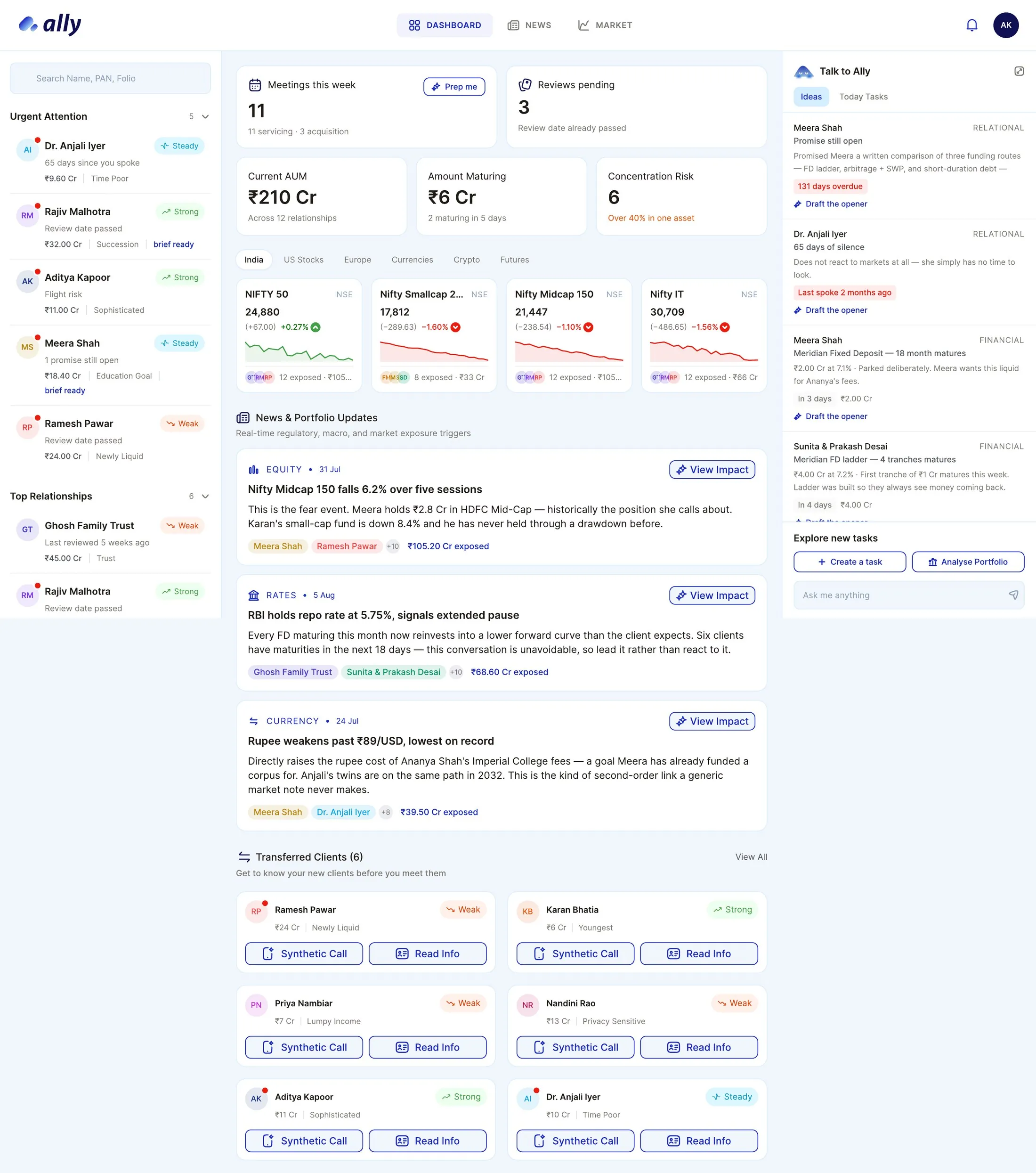
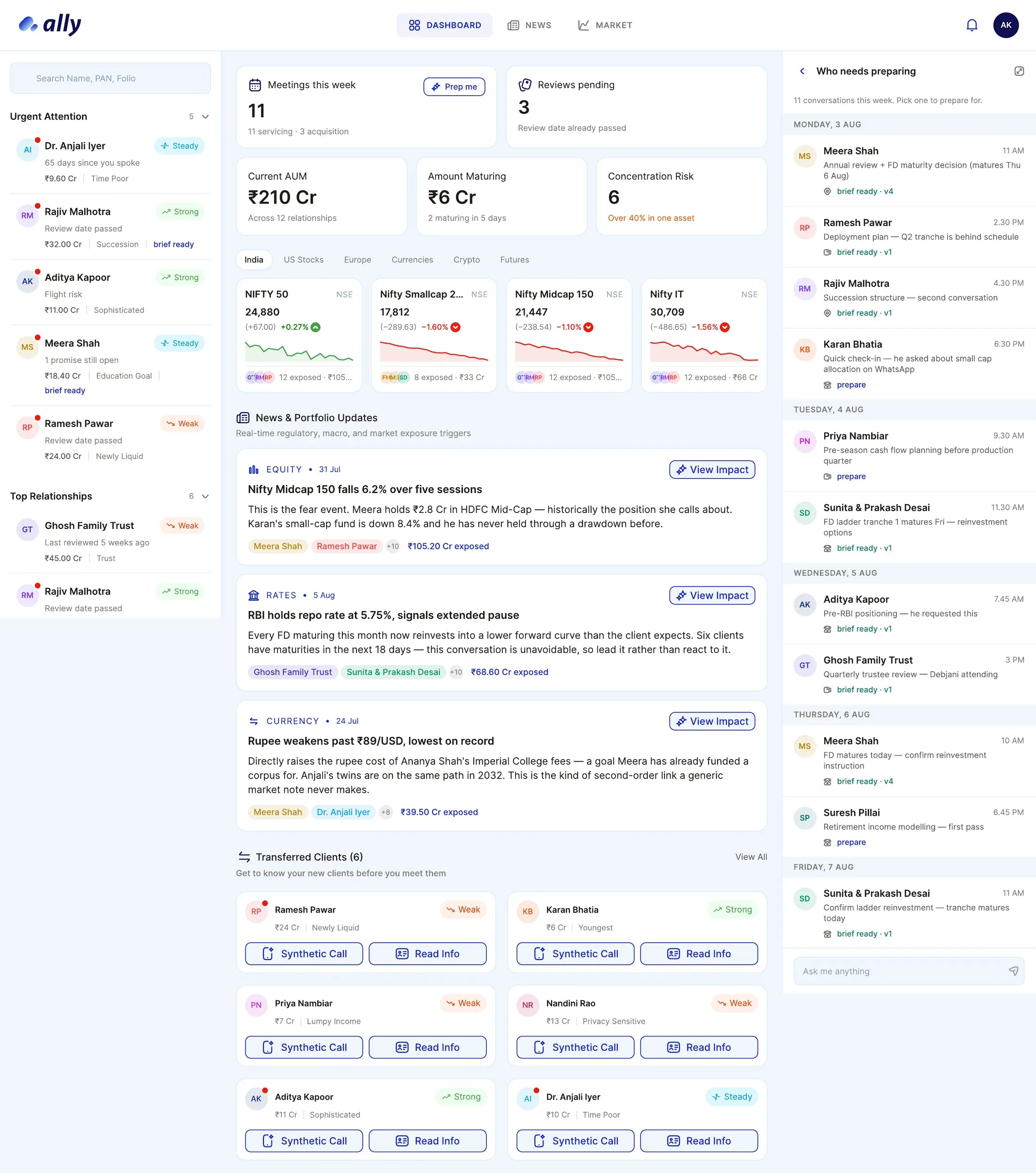
RMs didn't need another dashboard. They needed to walk into a conversation prepared. So the workspace follows the RM's day (what needs attention, who needs context, what happens next) rather than the firm's data silos.

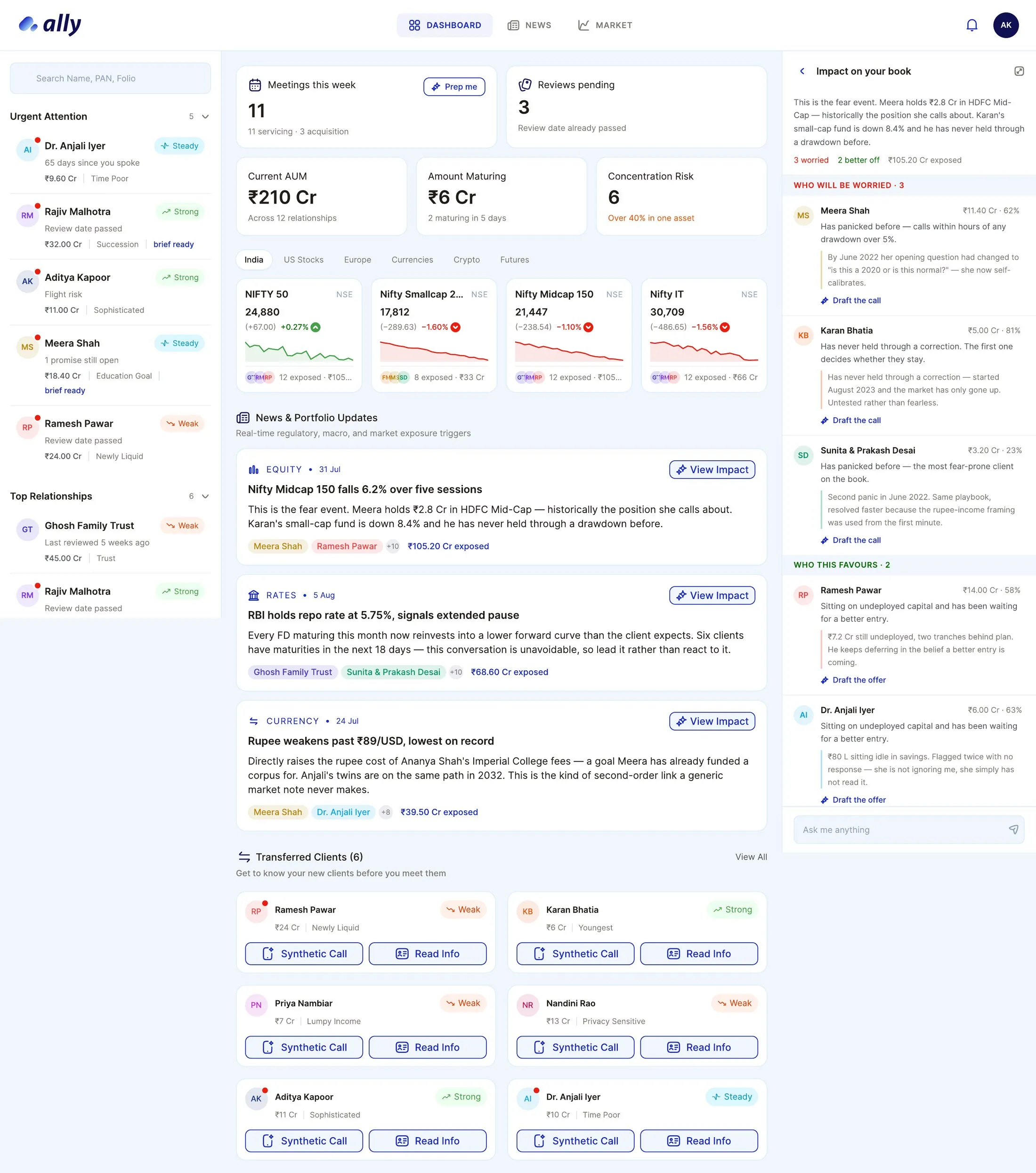
An "urgent attention" list with human cuesEach client shows a relationship status (Steady, Strong, Weak) and the reason it matters today: "65 days since you spoke", "Flight risk", "1 promise still open".
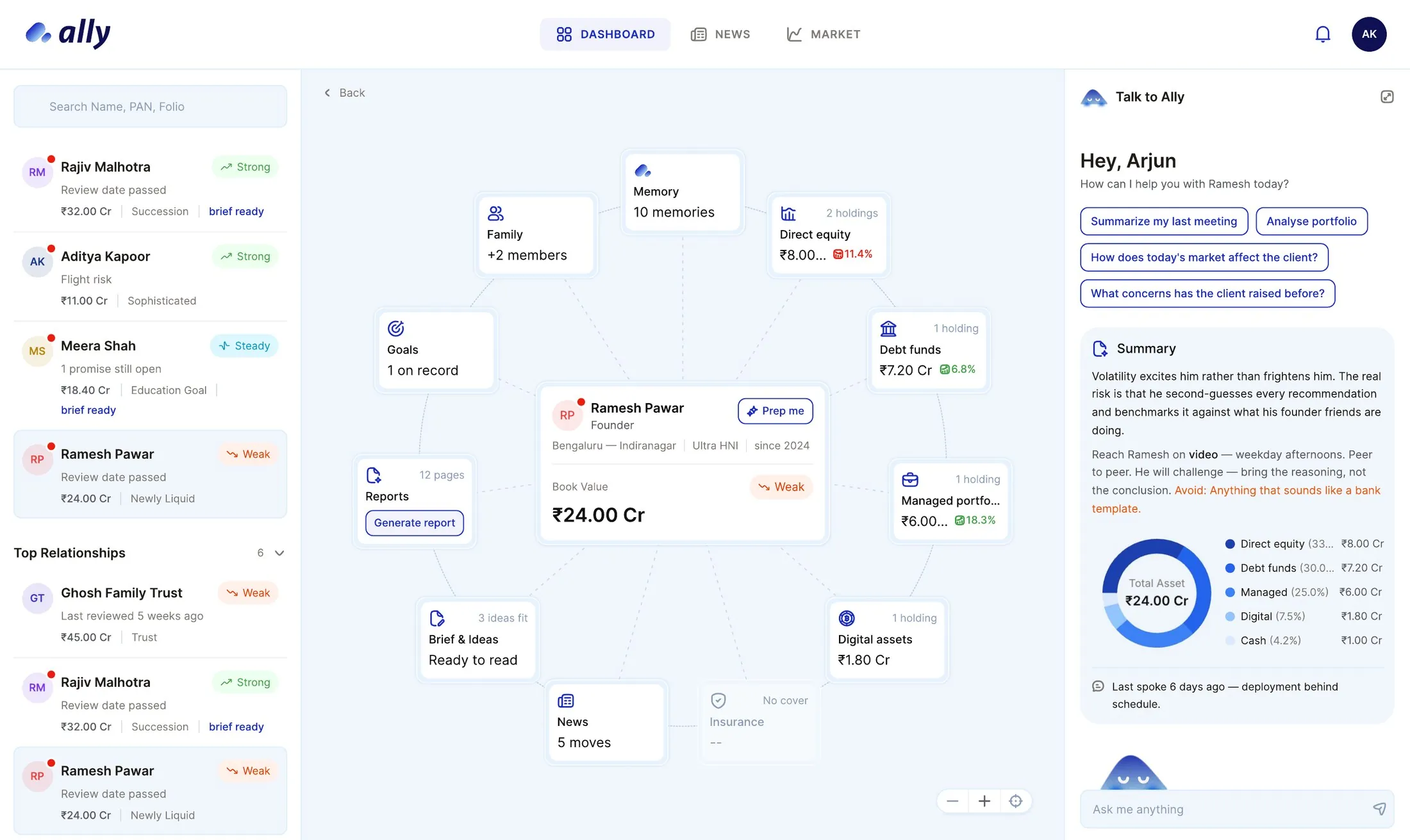
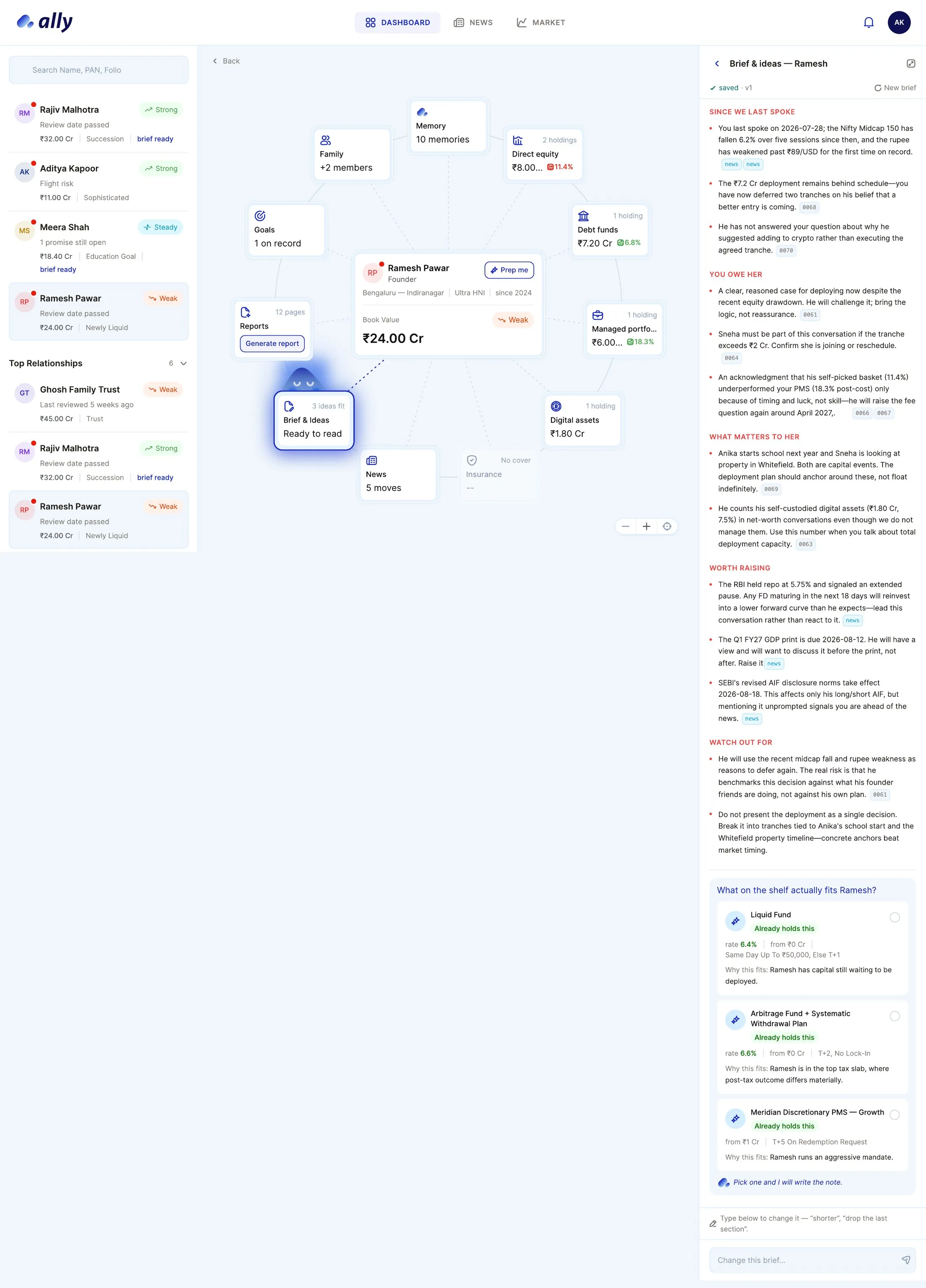
A relationship mapThe client sits at the centre, with everything around them: family, goals, memories, each type of holding, insurance, reports, ideas and news that affects them. Any node opens in a panel without leaving the map.
Talk to AllyA side panel summarises the client and answers questions such as "Summarise my last meeting" or "How does today's market affect this client?". The summary includes how the client likes to be reached: "WhatsApp after 20:30. Avoid calling during the day, she's in theatre." That one line is the difference between a CRM and a relationship.
The RM's day
01 / 03
Dashboard with urgent attention, market and news updates, and transferred clients
Scroll the screen ↓
01Urgent attention, with the reason it matters today
Prep status for every meeting this week
Scroll the screen ↓
02Who needs preparing, meeting by meeting
Relationship map with a holding opened in a side panel
03Any node opens in a panel, without leaving the map

All client names and figures in the prototype are fictional.

Decision 2Capture memory, but let the RM approve it

Most RM meetings happen in person, and notes get written later, if at all. During a call, the RM taps once to mark a moment (a new fact, a promise, a change in mood) without typing or looking away. Afterwards, Ally shows a memory diff: each item marked as heard, inferred or promised, for the RM to edit, confirm or reject. Nothing becomes part of the client record without review.

As the concept grew, we went a step further: recording and transcribing in-person meetings, the way online meetings already are, so the RM never has to take notes. It only works with the client's consent, and the same review step still applies.

Decision 3Explain why, then hand over to action

Ally doesn't just raise an alert; it shows its reasoning. For example: "₹18 Cr from an exit has sat in a liquid fund for 47 days. The client has said twice that he doesn't want to sit in cash." A memory trail shows where that came from, with dates. The RM then turns it into a task with an owner, a reason and a due date.

The result isn't an AI recommendation. It's a better-prepared RM with a clear next move. Every suggestion shows its source and confidence, and stays editable.
Reasons, with their sources
01 / 04
Brief and ideas for a meeting: since we last spoke, what you owe the client, what to watch out for
Scroll the screen ↓
01The brief: since we last spoke, what you owe, what to watch
News impact on the RM's book: who will be worried, who it favours
Scroll the screen ↓
02News, turned into who will be worried and who it favours
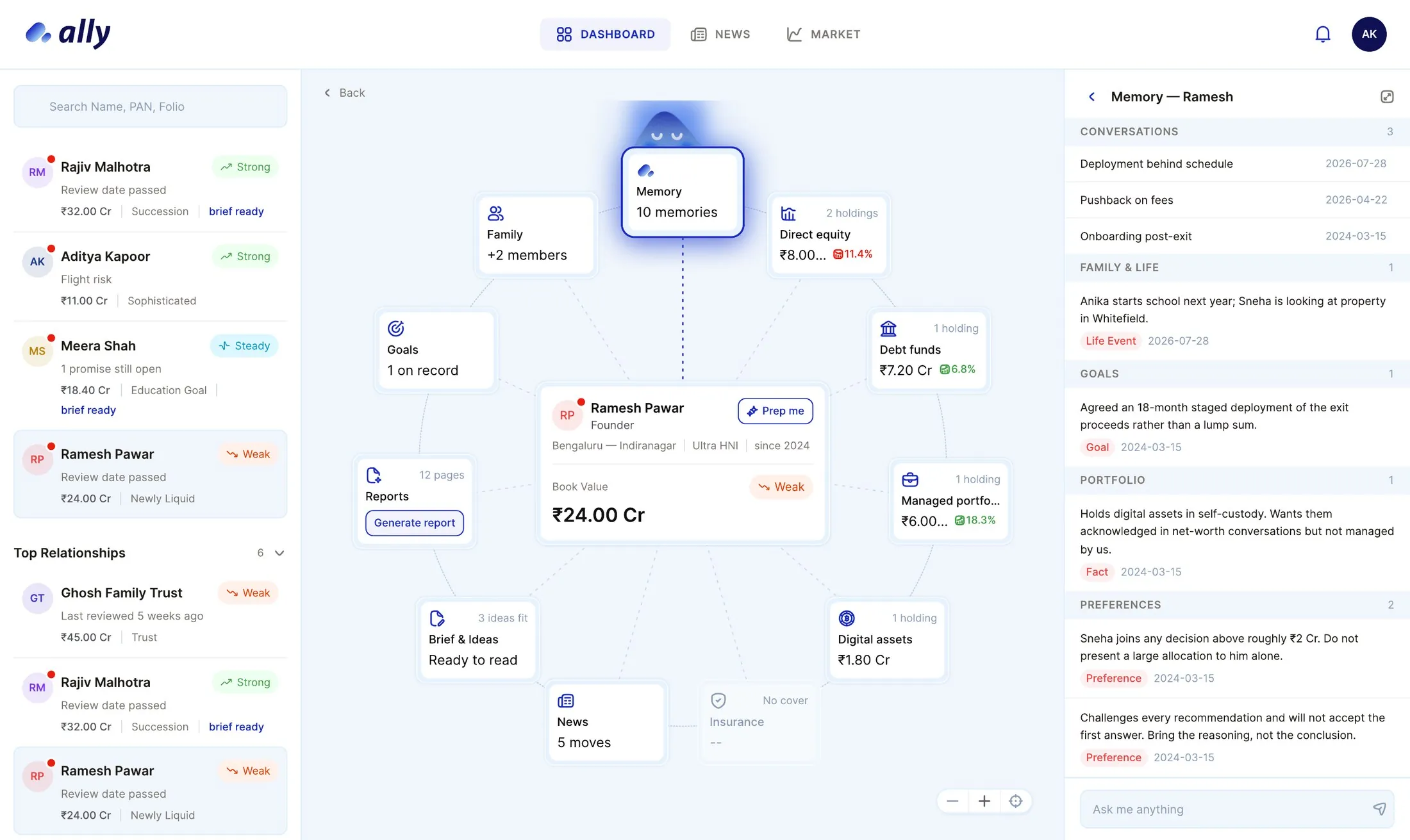
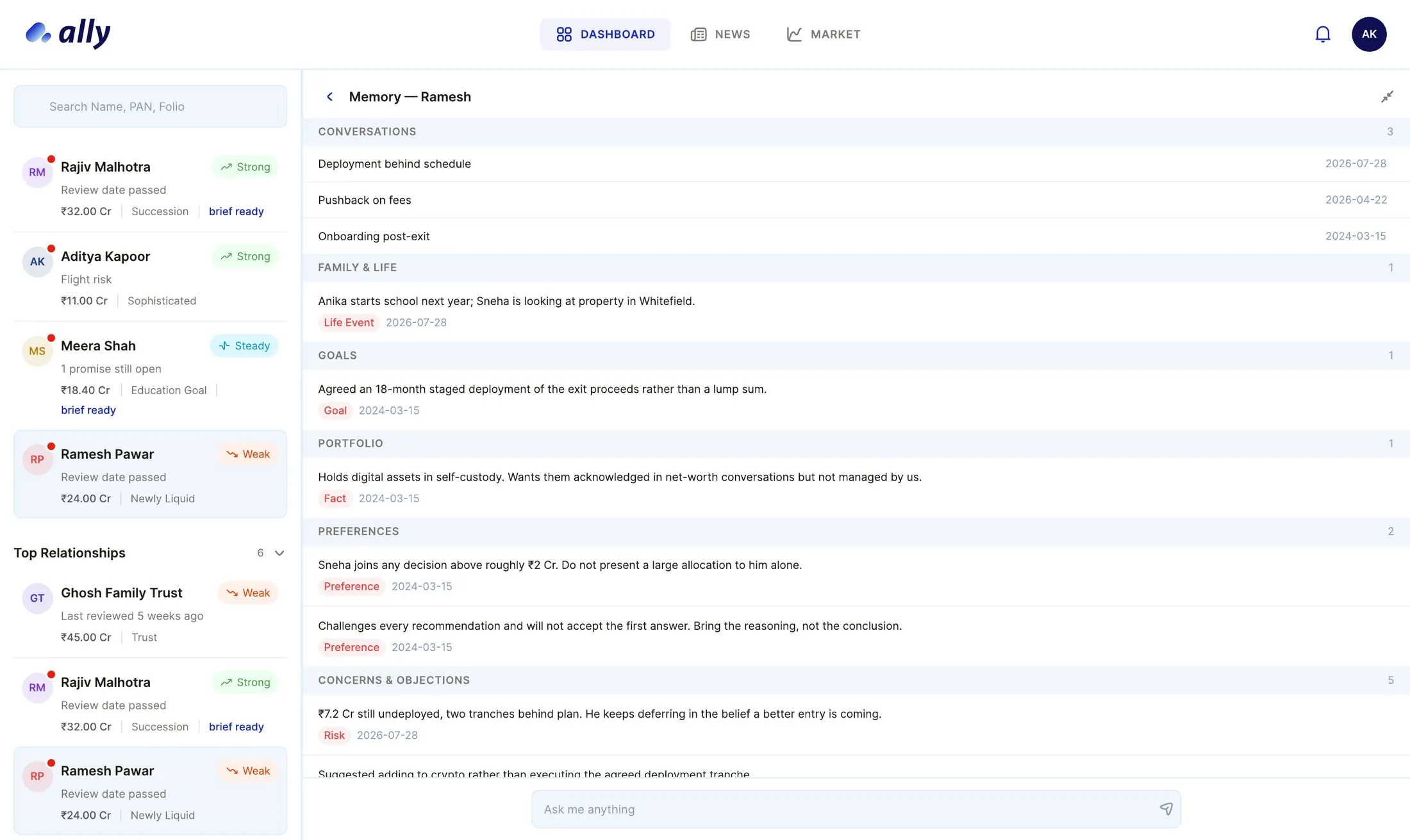
Memory, grouped by conversations, family, goals and preferences
03The memory, grouped the way an RM thinks
Memory expanded with dated entries
04Every memory dated, so its source is clear

Decision 4Rehearse the handover before meeting the client

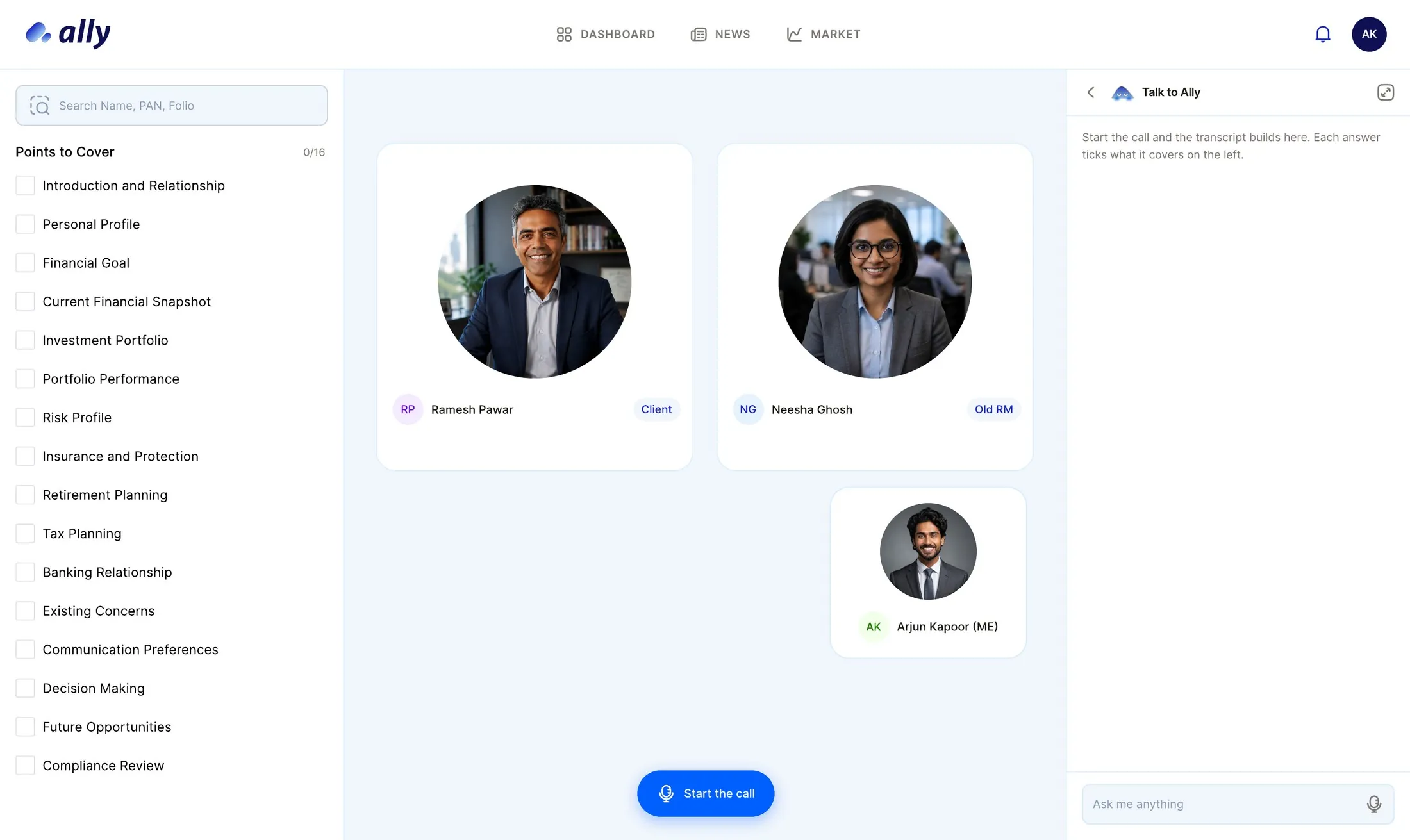
This is the idea I'm proudest of. When a client moves to a new RM, the new RM can hold a practice meeting with AI versions of the client and the previous RM, built from everything Ally has remembered. It's set up like a video call. The new RM asks questions out loud, the synthetic client answers in their own voice ("I'm comfortable with market fluctuations, but I don't like unnecessary risks"), and a checklist of 16 topics, from goals and risk profile to communication preferences and compliance, tracks what has been covered.

Reading notes tells a new RM what happened. A conversation tells them how the client thinks. The aim is to protect the client's trust, so the new RM doesn't repeat the previous one's mistakes.
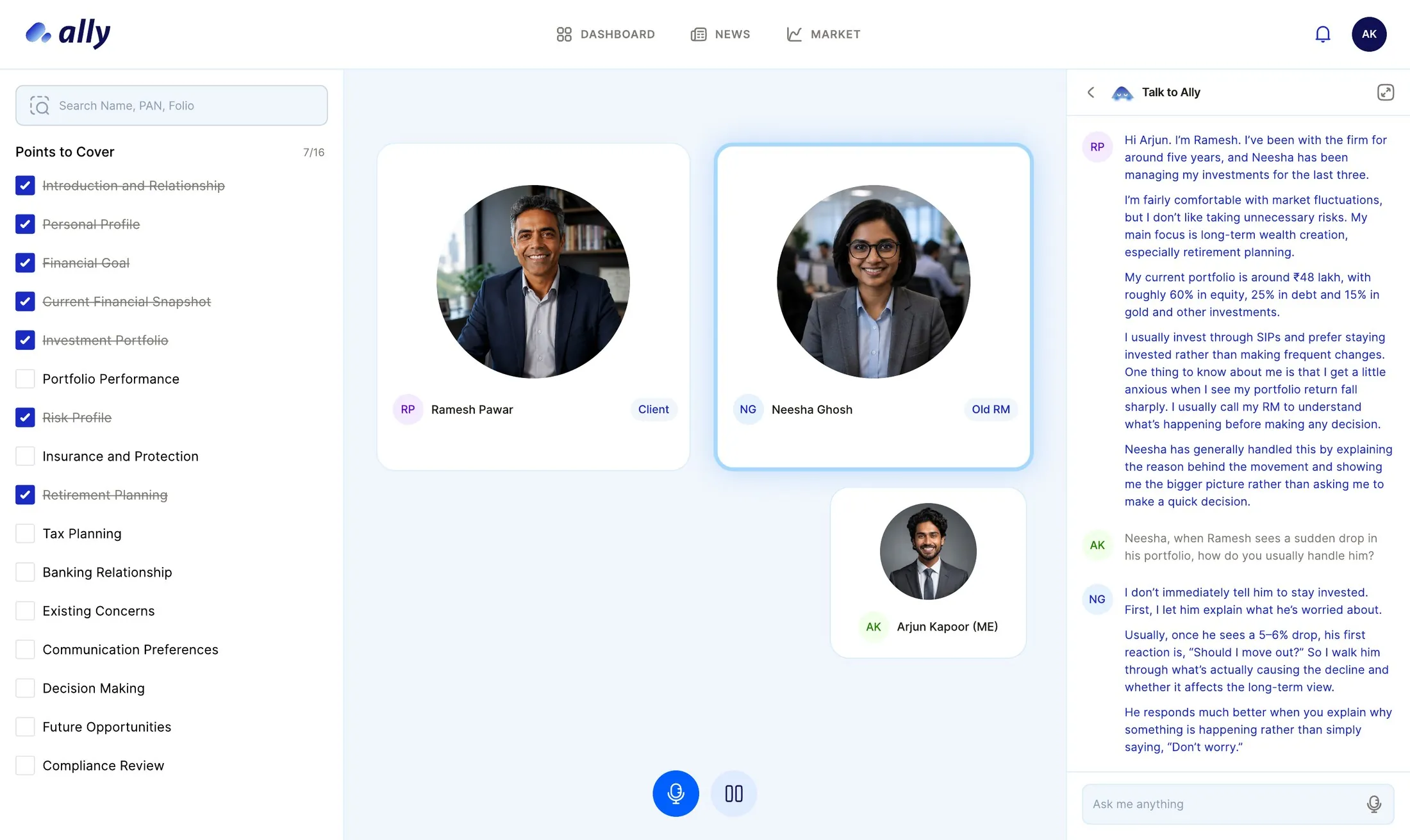
The handover rehearsal
01 / 02
Handover rehearsal before the call starts: the client, the previous RM and the new RM, with 16 points to cover
01Before the call: 16 points to cover
Handover rehearsal mid-call, with the transcript and topics ticked off
02Mid-call: the AI client answers, and topics tick off
The working prototype and the demo video aren't linked here. Walkthrough in interview
04

How we built it in two days

We kept the prototype deliberately narrow: prove one complete loop (prepare, capture, follow through) for one RM and one client story, then add to it.

Fifteen people worked in parallel. While designers built the screens, the developer set up a quick backend to fill the demo with realistic client data. Marketing named the product, the visual designers created the mascot, and the motion designer and marketing wrote and produced the demo video. My job was to hold the concept together, so every workstream was building the same product, and to design key screens myself.
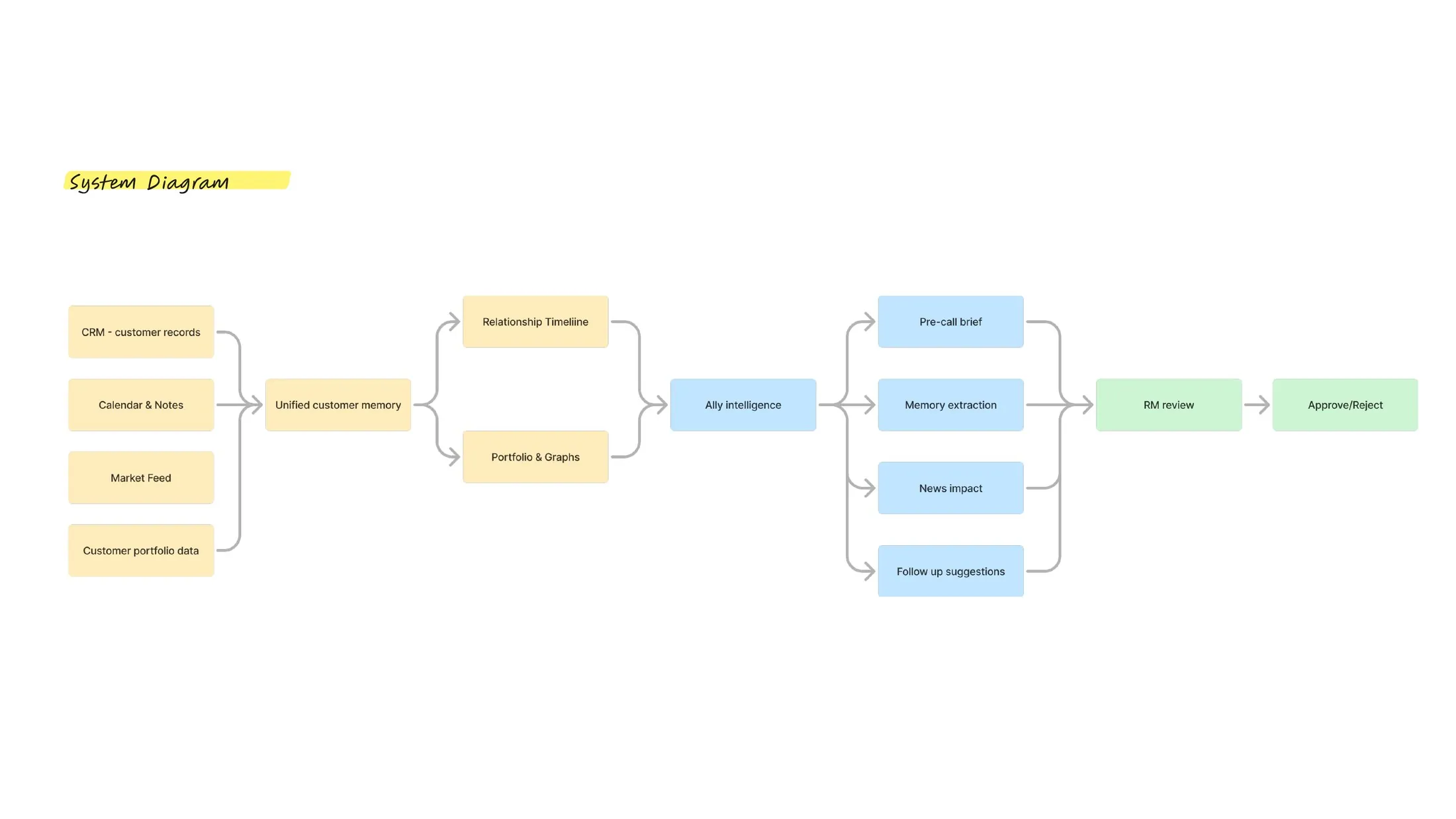
System diagram: CRM records, calendar and notes, market feed and portfolio data flow into a unified customer memory, then Ally's intelligence, then RM review and approval
The system: every source feeds one customer memory, and nothing reaches the record without the RM's review.
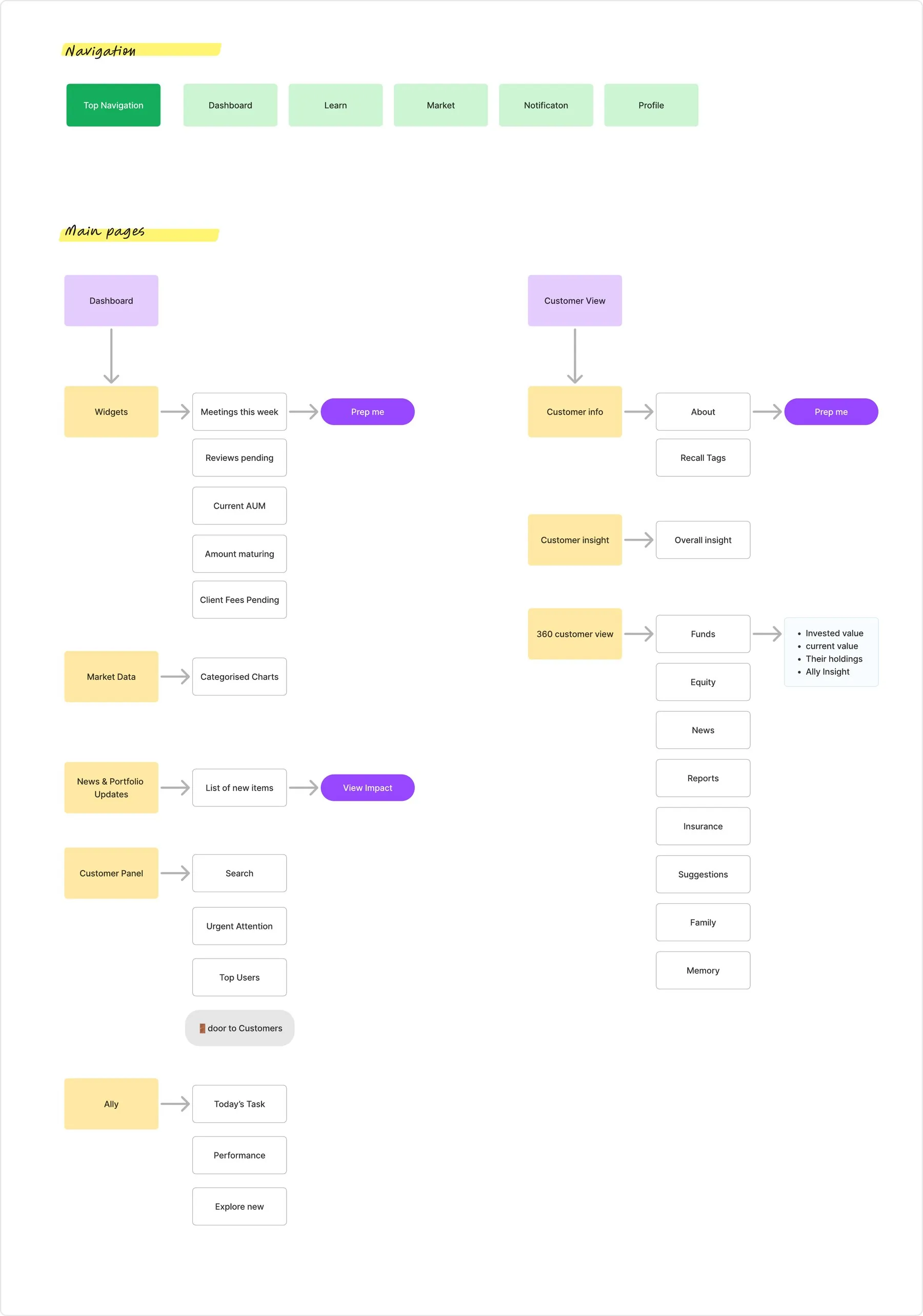
Information architecture: navigation, dashboard widgets and the customer view
The information architecture: a dashboard for the day, and a customer view for each relationship.
05

Outcome

Ally won SprintLY 2026, Lemon Yellow's first hackathon, against two other teams. Lemon Yellow now uses it to show clients how we build AI into a product, as a working demo rather than a slide.

hiring a senior or lead designer?

Let's talk.